
Review the engineering decisions.

This is a review framework, not a mandatory delivery process. Scale the depth to the consequence, uncertainty, and authority of the system.

1

Justification

Question

Why is AI necessary?

Review
  • Define the outcome that must improve and who benefits.
  • Compare AI with the simplest deterministic option.
  • Set measurable success criteria and unacceptable outcomes.
Prevent

Adding complexity, uncertainty, and operating cost without sufficient value.
2

Capability

Question

What is AI responsible for?

Review
  • Name the capability, such as generation, extraction, classification, summarization, translation, ranking, or recommendation.
  • Keep deterministic business rules in ordinary software whenever possible.
  • Define inputs, outputs, and responsibility boundaries.
Prevent

Using AI for deterministic business logic or giving it an undefined role.

3

Context

Question

What information may the system use?

Review
  • Approve sources and access rules.
  • Define freshness, provenance, trust, and privacy requirements.
  • Provide only the context required for the task.
Prevent

Unauthorized, stale, excessive, or untrusted information influencing results.

4

Authority

Question

What may the system do?

Review
  • Distinguish suggestions, drafts, decisions, and execution.
  • Apply policy checks, approvals, spending limits, and safety limits.
  • Record consequential actions and their authorizing identity.
Prevent

Treating AI output as permission to act or allowing uncontrolled automation.

5

Validation

Question

Which failures block release?

Review
  • Test representative scenarios, edge cases, and high-consequence failures.
  • Set owned release thresholds for the complete workflow.
  • Validate business outcomes independently from system confidence.
Prevent

Releasing a system that performs well on average but fails when it matters most.

6

Fallback

Question

What happens when AI cannot safely continue?

Review
  • Define a deterministic alternative or manual workflow.
  • Set escalation and bounded retry rules.
  • Degrade gracefully so the product can continue operating.
Prevent

Turning AI uncertainty, failure, or unavailability into complete workflow failure.

7

Operation

Question

Can the system be observed and controlled in production?

Review
  • Monitor user outcomes, workflow success, latency, cost, failures, and traces.
  • Make consequential side effects traceable.
  • Give operators a way to investigate, narrow, pause, or stop the system.
Prevent

Healthy infrastructure metrics masking failed user workflows or uncontrolled side effects.

8

Lifecycle

Question

Can the system evolve safely?

Review
  • Version behavior-changing inputs, dependencies, policies, and validation scenarios.
  • Assign an owner and define review triggers.
  • Provide rollback, replacement, and retirement paths.
Prevent

Production behavior changing without traceability, ownership, or a safe exit.

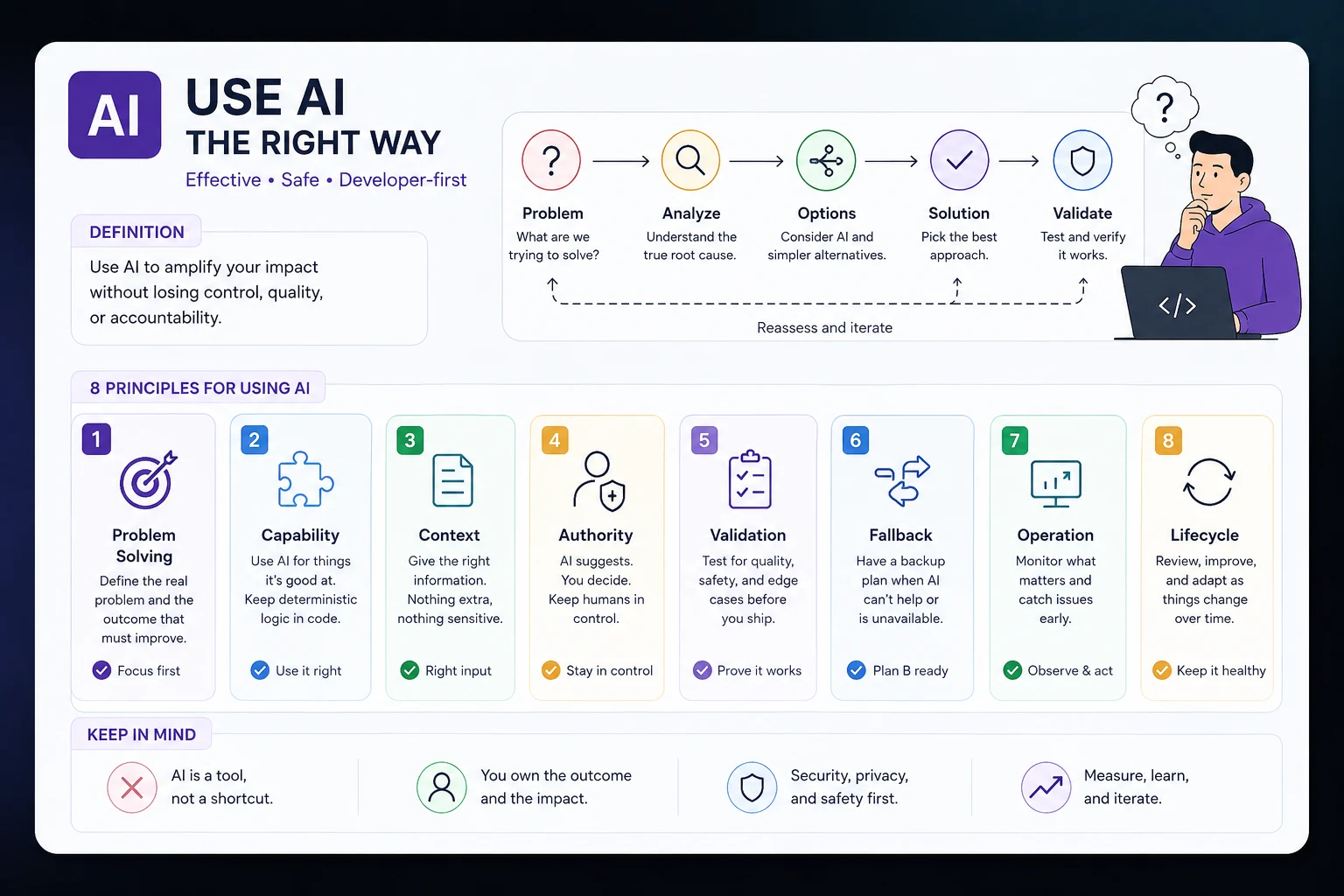
AI principles visual guide covering problem solving, capability, context, authority, validation, fallback, operation, and lifecycle